
OliOil, based in Turku, is developing a solution based on artificial intelligence and robotics, designed to minimize the need for human labor in oil spill response.
The company's system is designed to collect oil spills from ships, ports and the open sea as quickly as possible and largely autonomously. The system combines machine-learning algorithms with autonomous vessels equipped with sensors, enabling oil slicks to be detected, tracked and contained in real time.
«The idea was developed at the University of Lappeenranta in cooperation with a higher education institution in St Petersburg. In St. Petersburg, there was concern about the environmental risk to the Baltic Sea posed by many inexpensive single-hulled vessels,» states Kristian Laiho, Chairman of the OliOil Board of Directors.
Are there any competitors on the market for OliOil's solution?
«No direct equivalent,» says Laiho.
 What's the biggest stumbling block on the road to success?
«The first pilot is always difficult, whatever the product. It's often a question of financing, but also of proving in practice that the solution really works,» explains Laiho.
OliOil was recently ranked sixth among the most promising startups in the oil management category on a US-based startup list. One might assume that such recognition would easily attract investors.
«If we were operating in California, that would probably be the case. In Finland, it's the opposite. Unfortunately, we've fallen behind when it comes to corporate financing,» laments Laiho.A clear need for solutions
 The response to oil spills in shipping is still in its infancy. Worldwide, an estimated 5,500 to 6,000 tankers are in service, with a combined capacity of around 670 million deadweight tons. The average age of oil tankers is 15 to 20 years, but a significant number are already over 20 years old. An aging fleet increases the risk of accidents, particularly in busy maritime areas and ports.
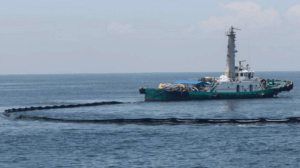
OliOil promises to reduce response time to 30 minutes using a spill response container installed directly on ships or in ports. The solution consists of a 40-foot container housing two 30-foot semi-autonomous vessels capable of deploying containment booms over a distance of around 300 meters.
«In the port of Singapore, for example, a 400-ton oil spill occurred. It took 15 hours before any action was taken. One of the reasons for this delay is that the spill response equipment is stored far from the harbour basin for cost reasons», explains Laiho.Significant growth expectations
«I believe our order book could reach 1,000 containers by 2030. Shipping lines will be our biggest customer group, followed by ports», predicts Laiho.
The price of a single container is estimated at around one million euros, which could result in hundreds of millions of euros in revenues.
Despite Laiho's critical remarks on the funding environment, OliOil secured private investment and public funding from the EU. With the funding obtained, the company completed its patenting processes, built its first physical product and moved on to the testing phase.
«Our solution reduces operational risks for personnel and shortens response times compared with manual cleaning methods. What's more, the technology enables both regular monitoring and emergency response by integrating with port and naval operations,» emphasizes Laiho.
Tekniikka & Talous*
*Editor : Harri Repo
Published : February 6, 2026
Source : teknikkatalous.fi

 English
  French